Story
On September 1 1993 at the behest of the Space Telescope Institute Council, and with support from NASA, AURA appoints the ‘HST and Beyond’ committee to study possible missions and programs for UVOIR astronomy in space for the first decades of the twenty-first century.
In 1995 The science instrument teams for the Near Infrared Camera (NIRCam) and the Mid-Infrared Instrument (MIRI) pass their critical design reviews and initiate construction of the flight instruments. All Webb's essential technologies are tested successfully under flight conditions. the HST & Beyond Committee’s report recommends, as a successor to Hubble, a significantly larger telescope with capabilities in the ultraviolet-optical-infrared (UVOIR) range. NASA selects Goddard Space Flight Center and the Space Telescope Science Institute to study its feasibility. Three independent government and aerospace teams determine that such an observatory is feasible.
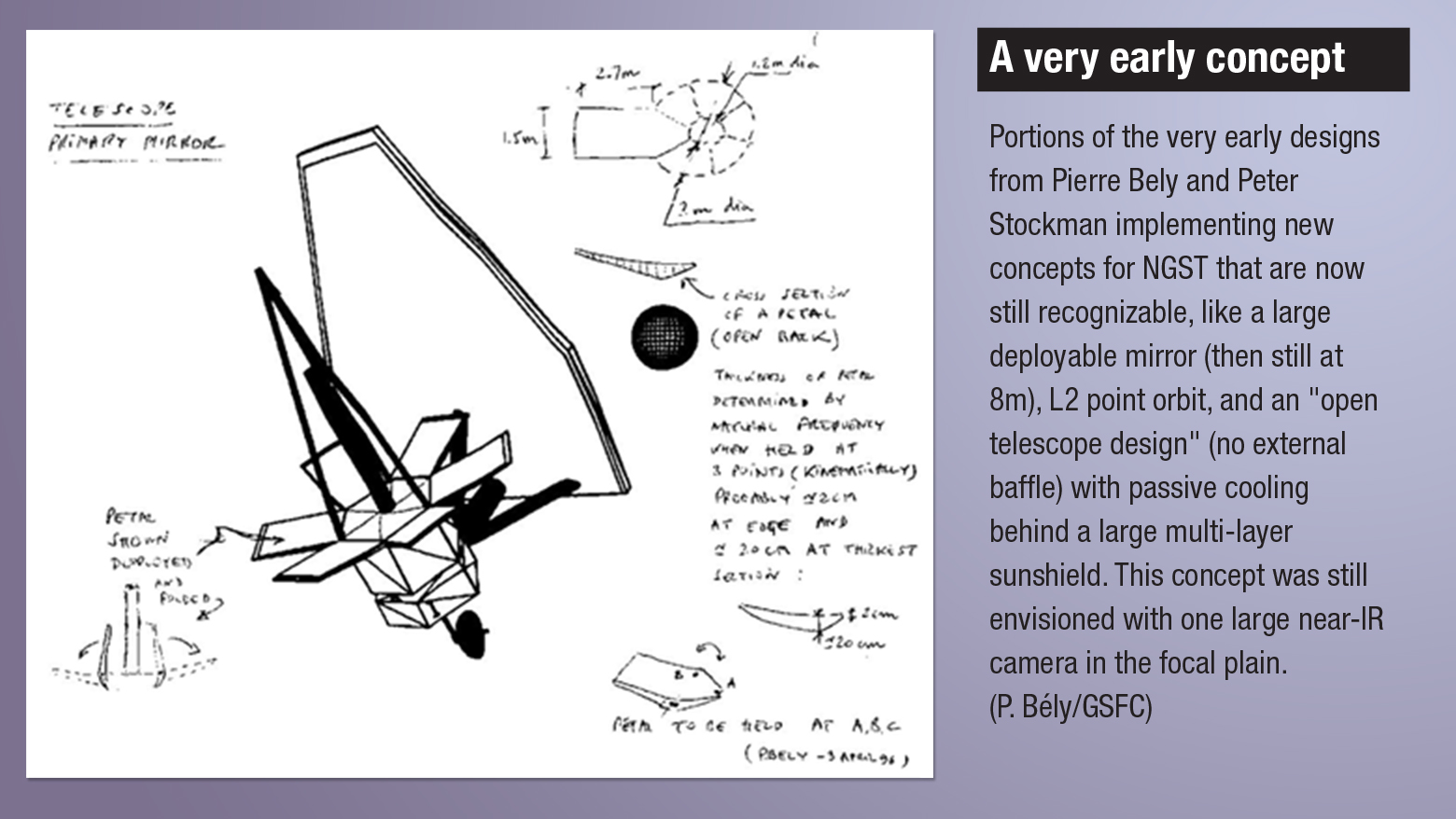
In 1997 NASA selects teams from the GSFC, TRW, and Ball Aerospace to explore the telescope’s possible technical design and estimate financial requirements.
In 2004 the construction begins on certain telescope parts that require extensive, long-term work — in particular, Webb's science instruments and the 18 segments of the primary mirror.
In 2005 NASA approves the use of the European Space Agency-provided Ariane 5 rocket to launch Webb into its operating orbit.
In 2006 the science instrument teams for the Near Infrared Camera (NIRCam) and the Mid-Infrared Instrument (MIRI) pass their critical design reviews and initiate construction of the flight instruments. All Webb's essential technologies are tested successfully under flight conditions.
From 2007 to 2008 NASA has the mission reviewed by internal and external groups. The internal “preliminary design review” and external “non-advocate review” concludes that the plans and designs have reached the maturity needed for NASA to commit to phases C and D. Phases C and D entail detailed design, procurement, testing, and assembly of telescope and observatory components. Construction begins in earnest.
In 2017 the final test of the integrated telescope and science instruments at Johnson Space Center completed.
JWST telescope was launched on December 25th 2021.