Mission
Webb will study every phase in the history of our universe, ranging from the first luminous glows after the big bang, to the formation of solar systems capable of supporting life on planets like Earth, to the evolution of our own solar system. It will build on the Hubble Space Telescope's discoveries. Webb launched Dec. 25, 2021, on an Ariane 5 rocket from Europe's Spaceport in French Guiana on the northeastern coast of South America. ESA (European Space Agency) provided the Ariane 5.
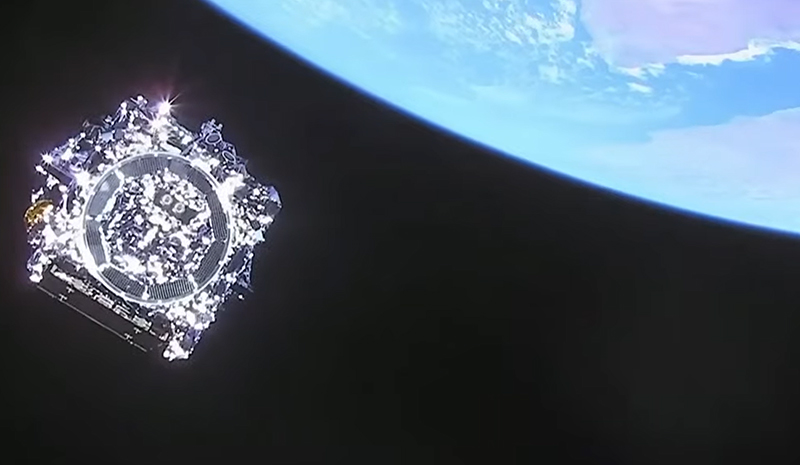
The James Webb Space Telescope is on its own after separating from the Arianespace Ariane 5 rocket that launched it into space. The spacecraft separated from the rocket 27 minutes into the flight at an altitude of approximately 870 miles (1,400 kilometers). Credit: NASA TV
Mission elapsed time
On Jan. 8, 2022, the Webb team fully deployed the telescope's
21-foot, gold-coated primary mirror,
successfully completing the final stage of all major spacecraft deployments to prepare for science
operations.
“The successful completion of all of the Webb Space Telescope’s deployments is historic,” said
Gregory L. Robinson, Webb program director at NASA Headquarters. “This is the first time a NASA-led
mission has ever attempted to complete a complex sequence to unfold an observatory in space – a
remarkable feat for our team, NASA, and the world.”
On Jan. 24, 2022, the mission team fired Webb’s thrusters and inserted the space telescope into
orbit around the Sun at the second Lagrange point, or L2, its final destination, nearly 1 million
miles from Earth.
“Webb, welcome home!” said NASA Administrator Bill Nelson. “Congratulations to the team for all of
their hard work ensuring Webb’s safe arrival at L2 today. We’re one step closer to uncovering the
mysteries of the universe. And I can’t wait to see Webb’s first new views of the universe this
summer!”
Webb's location gives it a wide view of the cosmos, and will keep the telescope's optics and
scientific instruments cold enough to function and perform optimal science.
On July 11, 2022, Pres. Joe Biden previewed the first full-color image from Webb – the deepest and
sharpest infrared image of the distant universe so far. Called Webb’s First Deep Field, the image
shows galaxy cluster SMACS 0723, a cluster teeming with thousands of galaxies – including the
faintest objects ever observed in the infrared.
The next day, July 12, 2022, more images were released showing the capabilities of all four of Webb’s state-of-the-art scientific instruments:
- SMACS 0723: Webb has delivered the deepest and sharpest infrared image of the distant universe so far – and in only 12.5 hours. For a person standing on Earth looking up, the field of view for this new image, a color composite of multiple exposures each about two hours long, is approximately the size of a grain of sand held at arm’s length. This deep field uses a lensing galaxy cluster to find some of the most distant galaxies ever detected. This image only scratches the surface of Webb’s capabilities in studying deep fields and tracing galaxies back to the beginning of cosmic time.
- WASP-96b (spectrum): Webb’s detailed observation of this hot, puffy planet outside our solar system reveals the clear signature of water, along with evidence of haze and clouds that previous studies of this planet did not detect. With Webb’s first detection of water in the atmosphere of an exoplanet, it will now set out to study hundreds of other systems to understand what other planetary atmospheres are made of.
- Southern Ring Nebula: This planetary nebula, an expanding cloud of gas that surrounds a dying star, is approximately 2,000 light-years away. Here, Webb’s powerful infrared eyes bring a second dying star into full view for the first time. From birth to death as a planetary nebula, Webb can explore the expelling shells of dust and gas of aging stars that may one day become a new star or planet.
- Stephan’s Quintet: Webb’s view of this compact group of galaxies, located in the constellation Pegasus, pierced through the shroud of dust surrounding the center of one galaxy to reveal the velocity and composition of the gas near its supermassive black hole. Now, scientists can get a rare look, in unprecedented detail, at how interacting galaxies are triggering star formation in each other and how the gas in these galaxies is being disturbed.
- Carina Nebula: Webb’s look at the “Cosmic Cliffs” in the Carina Nebula unveils the earliest, rapid phases of star formation that were previously hidden. Looking at this star-forming region in the southern constellation Carina, as well as others like it, Webb can see newly forming stars and study the gas and dust that made them. Webb was formerly known as the "Next Generation Space Telescope" (NGST); it was renamed in Sept. 2002 after former NASA administrator James Webb.
Webb is an international collaboration between NASA, the European Space Agency (ESA), and the Canadian Space Agency (CSA). The NASA Goddard Space Flight Center is managing the development effort. The main industrial partner is Northrop Grumman; the Space Telescope Science Institute is operating Webb after launch.