Gallery
1 / 22
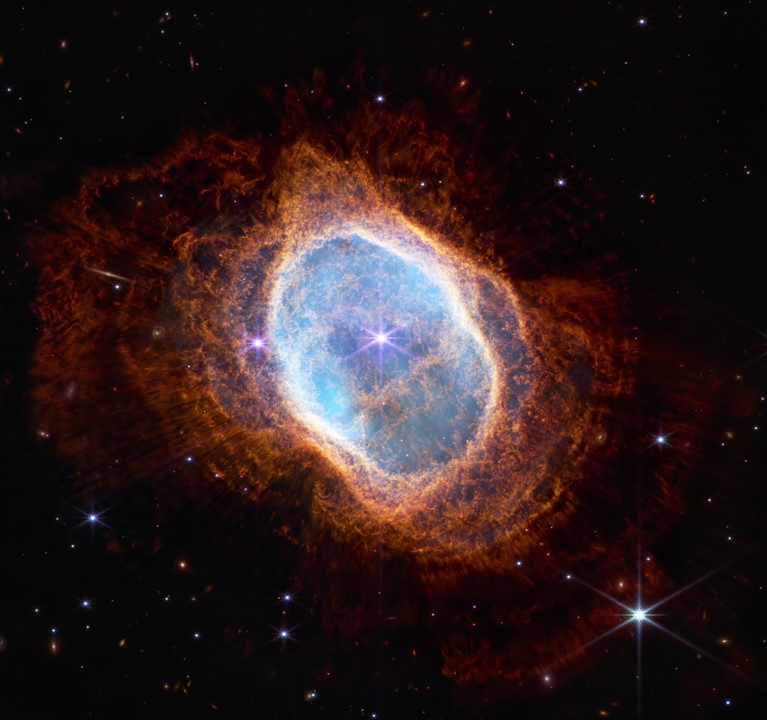
NGC 3132
The bright star at the center of NGC 3132, while
prominent when viewed by
NASA’s Webb Telescope
in near-infrared light, plays a supporting role in sculpting the surrounding nebula. A
second
star, barely visible at lower left along one of the bright star’s diffraction spikes, is the
nebula’s source. It has ejected at least eight layers of gas and dust over thousands of
years.
But the bright central star visible here has helped “stir” the pot, changing the shape of
this
planetary nebula’s highly intricate rings by creating turbulence. The pair of stars are
locked
in a tight orbit, which leads the dimmer star to spray ejected material in a range of
directions
as they orbit one another, resulting in these jagged rings.
Hundreds of straight, brightly-lit lines pierce through the rings of gas and dust. These
“spotlights” emanate from the bright star and stream through holes in the nebula like
sunlight
through gaps in a cloud.
But not all of the starlight can escape. The density of the central region, set off in teal,
is
reflected by how transparent or opaque it is. Areas that are a deeper teal indicate that the
gas
and dust are denser – and light is unable to break free.
Data from Webb’s Near-Infrared Camera (NIRCam) were used to make this extremely detailed
image.
It is teeming with scientific information – and research will begin following its release.
This is not only a crisp image of a planetary nebula – it also shows us objects in the vast
distances of space behind it. The transparent red sections of the planetary nebula – and all
the
areas outside it – are filled with distant galaxies.
Look for the bright angled line at the upper left. It is not starlight – it is a faraway
galaxy
seen edge-on. Distant spirals, of many shapes and colors, also dot the scene. Those that are
farthest away – or very dusty – are small and red.
For a full array of Webb’s first images and spectra, including downloadable files, please
visit:
https://webbtelescope.org/news/first-images
NIRCam was built by a team at the University of Arizona and Lockheed Martin’s Advanced
Technology Center.
Credits
IMAGE: NASA, ESA, CSA, STScI
2 / 22
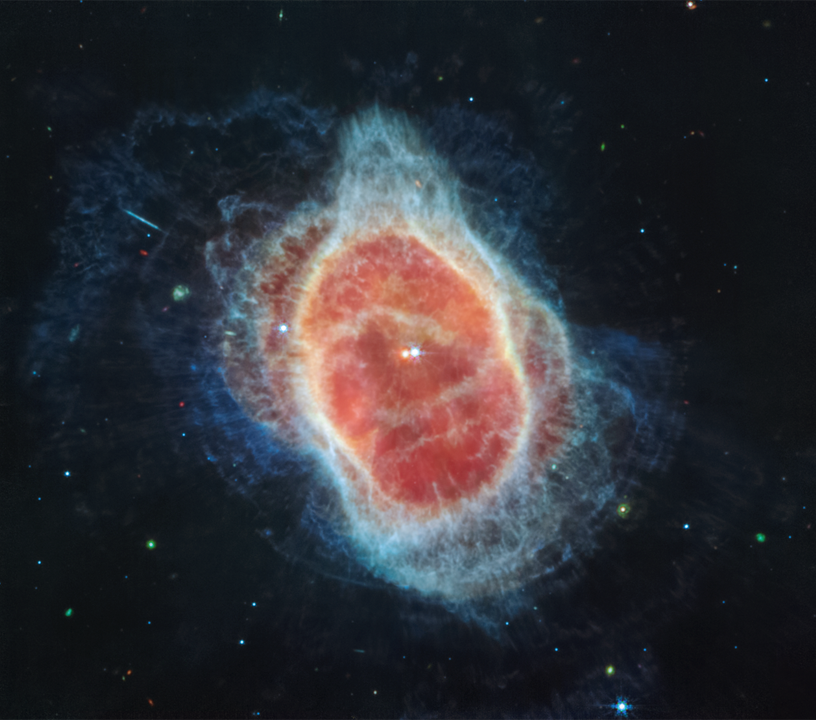
NGC 3132
NASA’s Webb Telescope has revealed the cloak of dust
around the second
star, shown at left in red, at the center of the Southern Ring Nebula for the first time. It
is
a hot, dense white dwarf star.
As it transformed into a white dwarf, the star periodically ejected mass – the shells of
material you see here. As if on repeat, it contracted, heated up – and then, unable to push
out
more material, pulsated.
At this stage, it should have shed its last layers. So why is the red star still cloaked in
dust? Was material transferred from its companion? Researchers will begin to pursue answers
soon.
The bluer star at right in this image has also shaped the scene. It helps stir up the
ejected
material. The disk around the stars is also wobbling, shooting out spirals of gas and dust
over
long periods of time. This scene is like witnessing a rotating sprinkler that’s finished
shooting out material in all directions over thousands of years.
Webb captured this scene in mid-infrared light – most of which can only be observed from
space.
Mid-infrared light helps researchers detect objects enshrouded in dust, like the red star.
This Mid-Infrared Instrument (MIRI) image also offers an incredible amount of detail,
including
a cache of distant galaxies in the background. Most of the multi-colored points of light are
galaxies, not stars. Tiny triangles mark the circular edges of stars, including a blue one
within the nebula’s red bottom-most edges, while galaxies look like misshapen circles,
straight
lines, and spirals.
For a full array of Webb’s first images and spectra, including downloadable files, please
visit:
https://webbtelescope.org/news/first-images
MIRI was contributed by ESA and NASA, with the instrument designed and built by a consortium
of
nationally funded European Institutes (The MIRI European Consortium) in partnership with JPL
and
the University of Arizona.
Credits
IMAGE: NASA, ESA, CSA, STScI
3 / 22
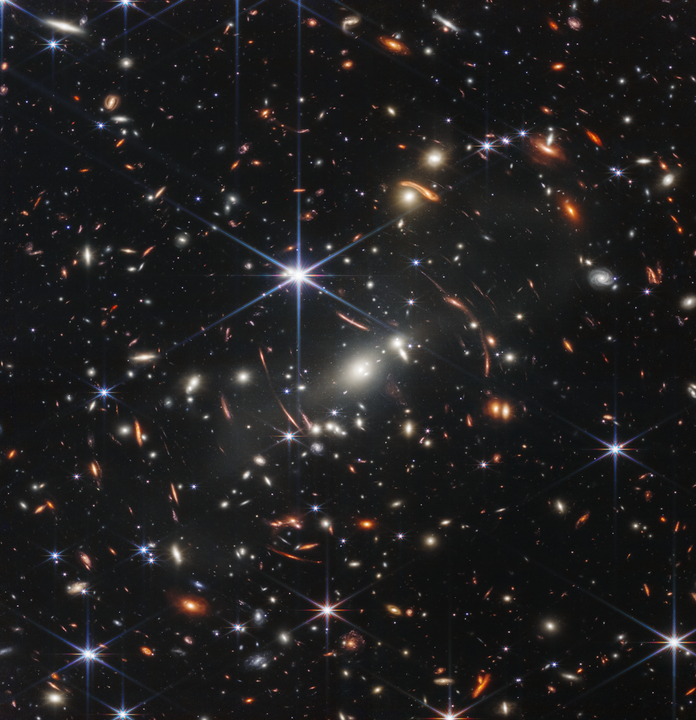
SMACS 0723
Thousands of galaxies flood this near-infrared image of
galaxy cluster
SMACS 0723. High-resolution imaging from NASA’s James Webb Space Telescope combined with a
natural effect known as gravitational lensing made this finely detailed image possible.
First, focus on the galaxies responsible for the lensing: the bright white elliptical galaxy
at
the center of the image and smaller white galaxies throughout the image. Bound together by
gravity in a galaxy cluster, they are bending the light from galaxies that appear in the
vast
distances behind them. The combined mass of the galaxies and dark matter act as a cosmic
telescope, creating magnified, contorted, and sometimes mirrored images of individual
galaxies.
Clear examples of mirroring are found in the prominent orange arcs to the left and right of
the
brightest cluster galaxy. These are lensed galaxies – each individual galaxy is shown twice
in
one arc. Webb’s image has fully revealed their bright cores, which are filled with stars,
along
with orange star clusters along their edges.
Not all galaxies in this field are mirrored – some are stretched. Others appear scattered by
interactions with other galaxies, leaving trails of stars behind them.
Webb has refined the level of detail we can observe throughout this field. Very diffuse
galaxies
appear like collections of loosely bound dandelion seeds aloft in a breeze. Individual
“pods” of
star formation practically bloom within some of the most distant galaxies – the clearest,
most
detailed views of star clusters in the early universe so far.
One galaxy speckled with star clusters appears near the bottom end of the bright central
star’s
vertical diffraction spike – just to the right of a long orange arc. The long, thin
ladybug-like
galaxy is flecked with pockets of star formation. Draw a line between its “wings” to roughly
match up its star clusters, mirrored top to bottom. Because this galaxy is so magnified and
its
individual star clusters are so crisp, researchers will be able to study it in exquisite
detail,
which wasn’t previously possible for galaxies this distant.
The galaxies in this scene that are farthest away – the tiniest galaxies that are located
well
behind the cluster – look nothing like the spiral and elliptical galaxies observed in the
local
universe. They are much clumpier and more irregular. Webb’s highly detailed image may help
researchers measure the ages and masses of star clusters within these distant galaxies. This
might lead to more accurate models of galaxies that existed at cosmic “spring,” when
galaxies
were sprouting tiny “buds” of new growth, actively interacting and merging, and had yet to
develop into larger spirals. Ultimately, Webb’s upcoming observations will help astronomers
better understand how galaxies form and grow in the early universe.
NIRCam was built by a team at the University of Arizona and Lockheed Martin’s Advanced
Technology Center.
For a full array of Webb’s first images and spectra, including downloadable files, please
visit:
https://webbtelescope.org/news/first-images
Credits
IMAGE: NASA, ESA, CSA, STScI
4 / 22
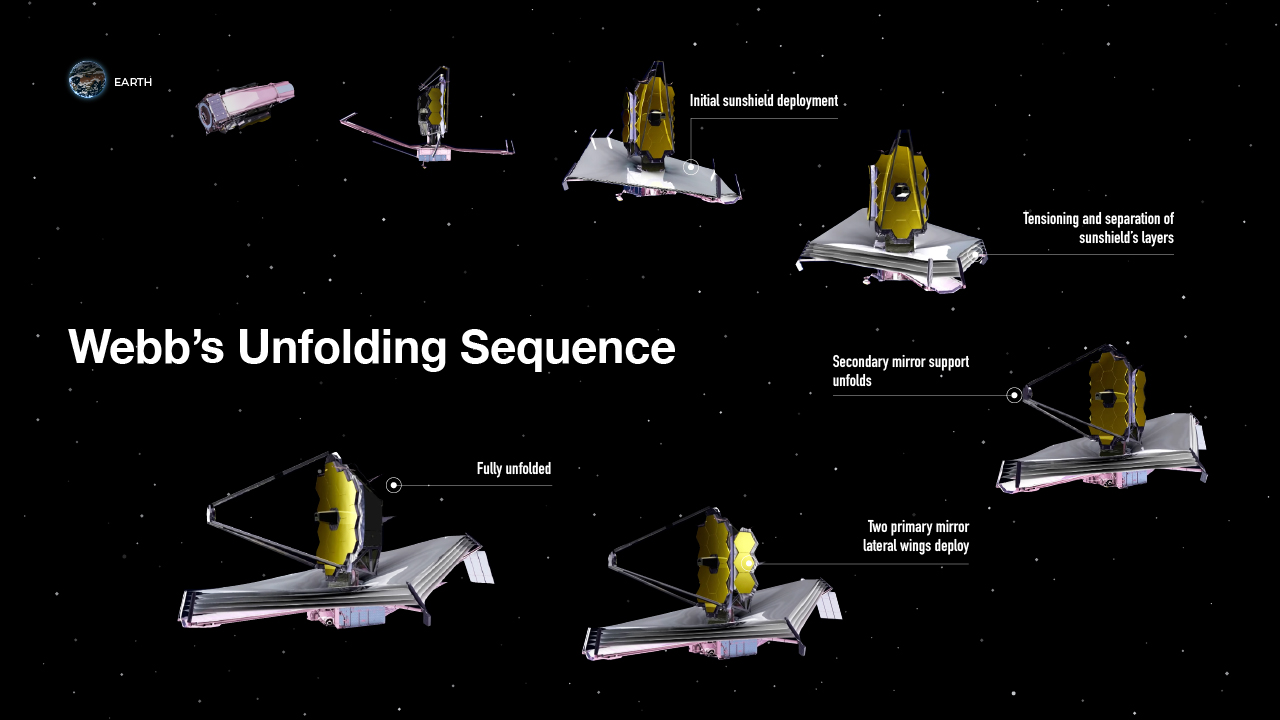
WEBB'S UNFOLDING SEQUENCE
In 2021, Webb was carefully folded up and loaded onto a
ship, which
passed through the Panama Canal on its way to French Guiana in South America, where it
reached
its launch site at the European Spaceport located near Kourou. It is beneficial for launch
sites
to be located near the equator: The spin of the Earth can help give an additional push to
the
rocket.
After launch and during the first month in space, on its way to the second Langrange point
(L2),
Webb undergoes a complex unfolding sequence.
Steps include:
Deploying, tensioning, and separating Webb’s sunshield, a five-layer, diamond-shaped
structure
the size of a tennis court; extending its secondary mirror support structure; and unfolding
its
primary mirror, which has a honeycomb-like pattern of 18 hexagonal, gold-coated mirror
segments.
Deployment and commissioning take time—at least six months. Engineers and scientists
carefully
activate and confirm each and every instrument works properly before the first—but still
unfocused—image of a star field is delivered about two months after launch.
In the fourth month after launch, Webb completes its first orbit around L2—and takes the
first
focused image. This shows that the mirrors are aligned.
After the six-month mark, Webb begins its science mission and starts to conduct routine
science
operations.
Find more detail about the telescope’s size, mirrors, sunshield, orbit, and more.
Credits
IMAGE: NASA, ESA, CSA, Joyce Kang (STScI)
5 / 22
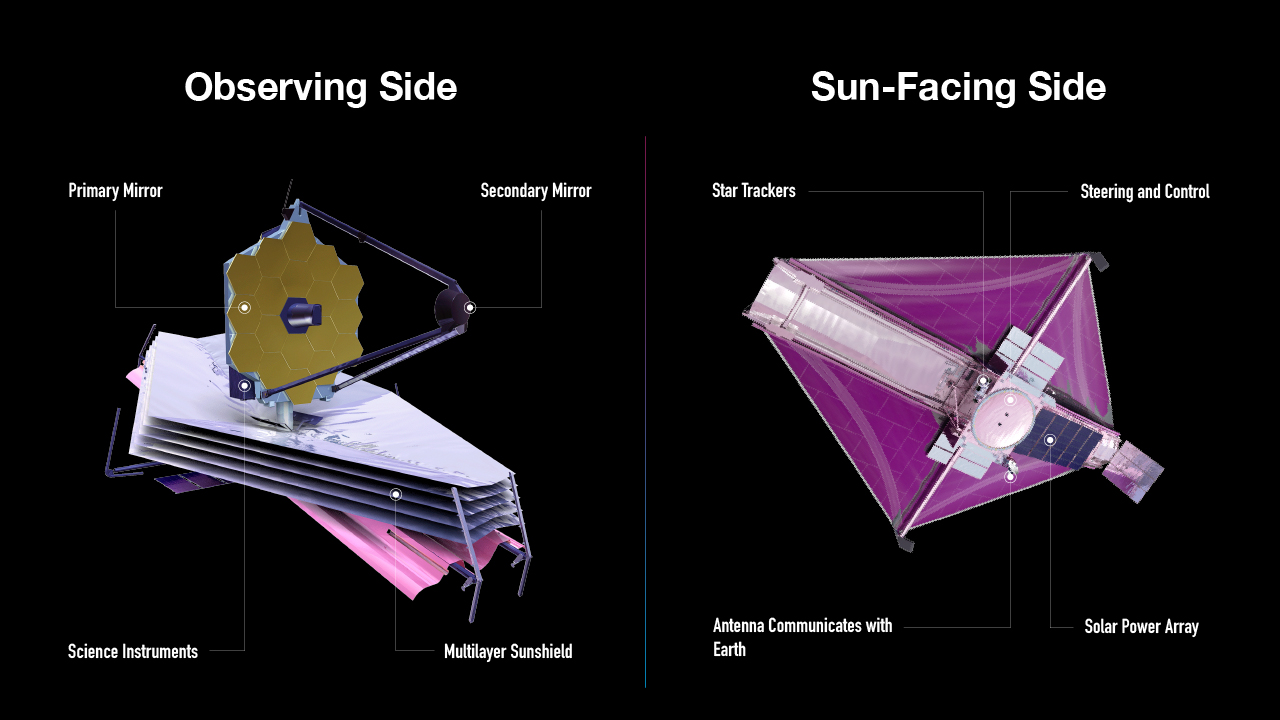
OBSERVING SIDE AND SUN-FACING SIDE
The James Webb Space Telescope has a cool side, which
faces away from the
Sun, and a hot side, which faces the Sun.
Webb’s tennis court-sized sunshield protects the telescope from external sources of light
and
heat, which ensures it can detect faint heat signals from very distant objects. It’s very
important for its observing side to be very, very cold.
The lower part of Webb, where its five-layered sunshield is, faces the Sun. This is where
its
equipment that does not need to be cooled, like its solar panel, antennae, computer,
gyroscopes,
and navigational jets, are.
Webb’s science instruments are housed behind the mirror, separated from the warm
communications
and control technology by the sunshield.
Find more detail about the telescope’s size, mirrors, sunshield, orbit, and more.
Credits
IMAGE: NASA, ESA, CSA, Joyce Kang (STScI)
6 / 22
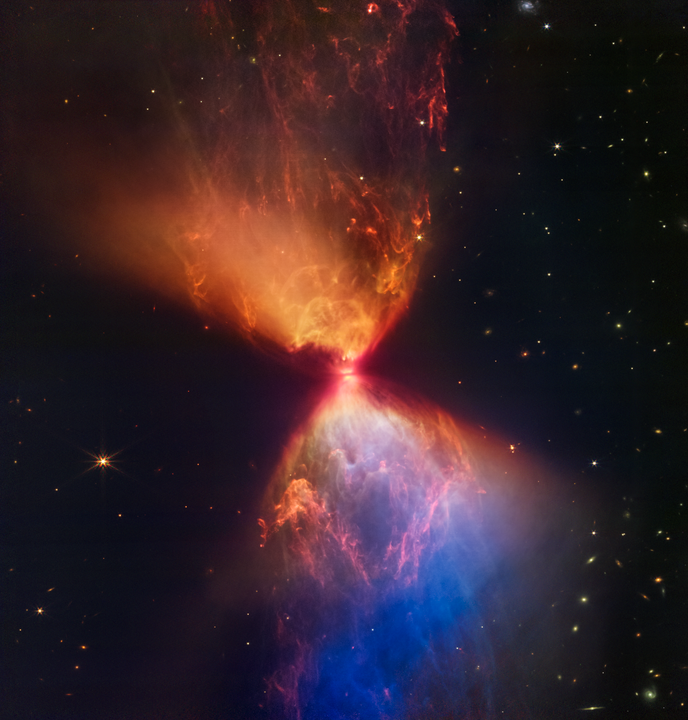
L1527
The protostar within the dark cloud L1527, shown in this
image from
NASA’s James Webb Space Telescope Near-Infrared Camera (NIRCam), is embedded within a cloud
of
material feeding its growth. Ejections from the star have cleared out cavities above and
below
it, whose boundaries glow orange and blue in this infrared view. The upper central region
displays bubble-like shapes due to stellar “burps,” or sporadic ejections. Webb also detects
filaments made of molecular hydrogen that has been shocked by past stellar ejections. The
edges
of the cavities at upper left and lower right appear straight, while the boundaries at upper
right and lower left are curved. The region at lower right appears blue, as there’s less
dust
between it and Webb than the orange regions above it.
Credits
SCIENCE: NASA, ESA, CSA, STScI
IMAGE PROCESSING: Joseph DePasquale (STScI), Alyssa Pagan (STScI), Anton M. Koekemoer
(STScI)
7 / 22
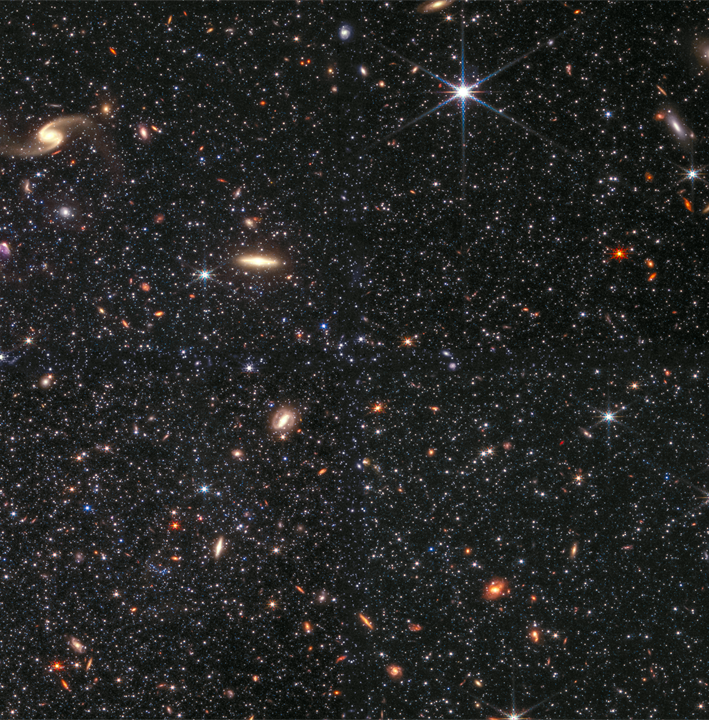
WOLF-LUNDMARK-MELOTTE (WLM)
A portion of the dwarf galaxy Wolf–Lundmark–Melotte
(WLM) captured by the
James Webb Space Telescope’s Near-Infrared Camera. The image demonstrates Webb’s remarkable
ability to resolve faint stars outside the Milky Way. Color translation: 0.9-micron light is
shown in blue, 1.5-micron in cyan, 2.5-micron in yellow, and 4.3-micron in red (filters
F090W,
F150W, F250M, and F430M).
Read the story, watch a zoom-in, or explore a side-by-side comparison.
Credits
SCIENCE: NASA, ESA, CSA, Kristen McQuinn (RU)
IMAGE PROCESSING: Zolt G. Levay (STScI)
8 / 22
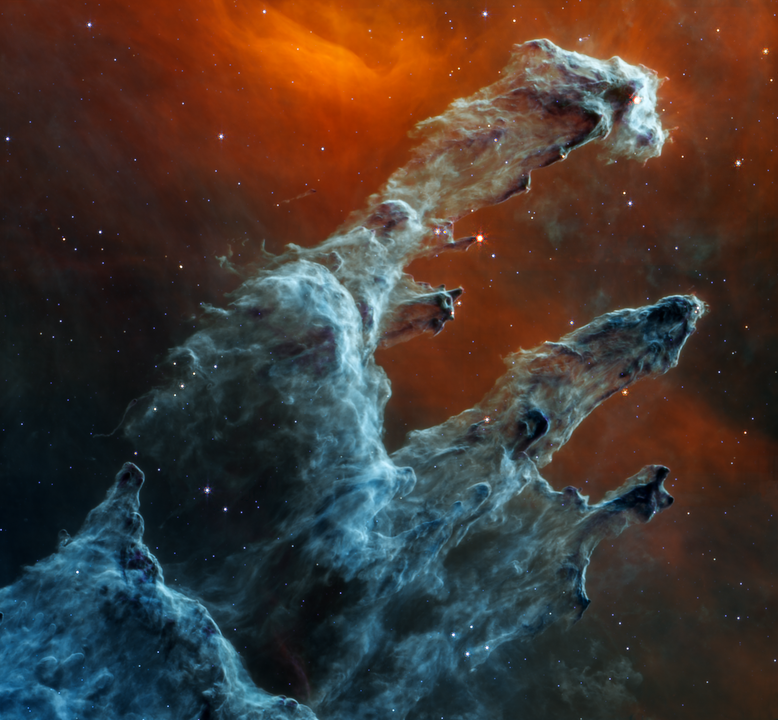
THE PILLARS OF CREATION
NASA’s James Webb Space Telescope’s mid-infrared view of
the Pillars of
Creation strikes a chilling tone. Thousands of stars that exist in this region disappear –
and
seemingly endless layers of gas and dust become the centerpiece.
The detection of dust by Webb’s Mid-Infrared Instrument (MIRI) is extremely important – dust
is
a major ingredient for star formation. Many stars are actively forming in these dense
blue-gray
pillars. When knots of gas and dust with sufficient mass form in these regions, they begin
to
collapse under their own gravitational attraction, slowly heat up – and eventually form new
stars.
Although the stars appear missing, they aren’t. Stars typically do not emit much
mid-infrared
light. Instead, they are easiest to detect in ultraviolet, visible, and near-infrared light.
In
this MIRI view, two types of stars can be identified. The stars at the end of the thick,
dusty
pillars have recently eroded the material surrounding them. They show up in red because
their
atmospheres are still enshrouded in cloaks of dust. In contrast, blue tones indicate stars
that
are older and have shed most of their gas and dust.
Mid-infrared light also details dense regions of gas and dust. The red region toward the
top,
which forms a delicate V shape, is where the dust is both diffuse and cooler. And although
it
may seem like the scene clears toward the bottom left of this view, the darkest gray areas
are
where densest and coolest regions of dust lie. Notice that there are many fewer stars and no
background galaxies popping into view.
Webb’s mid-infrared data will help researchers determine exactly how much dust is in this
region
– and what it’s made of. These details will make models of the Pillars of Creation far more
precise. Over time, we will begin to more clearly understand how stars form and burst out of
these dusty clouds over millions of years.
Contrast this view with Webb’s near-infrared light image.
MIRI was contributed by ESA and NASA, with the instrument designed and built by a
consortium of
nationally funded European Institutes (the MIRI European Consortium) in partnership with
JPL and
the University of Arizona.
Credits
SCIENCE: NASA, ESA, CSA, STScI
IMAGE PROCESSING: Joseph DePasquale (STScI), Alyssa Pagan (STScI)
9 / 22
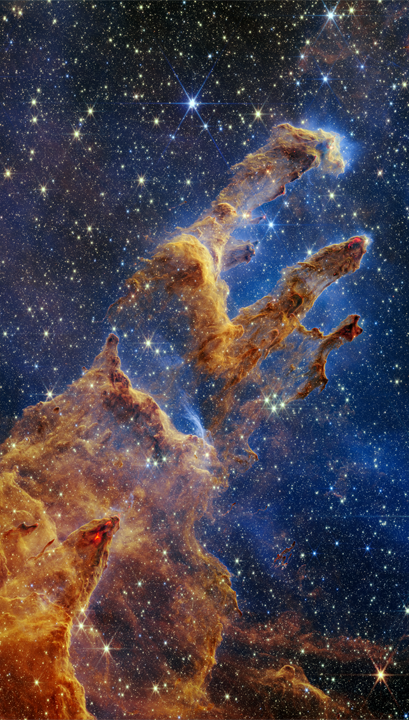
THE PILLARS OF CREATION
The Pillars of Creation are set off in a kaleidoscope of
color in NASA’s
James Webb Space Telescope’s near-infrared-light view. The pillars look like arches and
spires
rising out of a desert landscape, but are filled with semi-transparent gas and dust, and
ever
changing. This is a region where young stars are forming – or have barely burst from their
dusty
cocoons as they continue to form.
Newly formed stars are the scene-stealers in this Near-Infrared Camera (NIRCam) image. These
are
the bright red orbs that sometimes appear with eight diffraction spikes. When knots with
sufficient mass form within the pillars, they begin to collapse under their own gravity,
slowly
heat up, and eventually begin shining brightly.
Along the edges of the pillars are wavy lines that look like lava. These are ejections from
stars that are still forming. Young stars periodically shoot out supersonic jets that can
interact within clouds of material, like these thick pillars of gas and dust. This sometimes
also results in bow shocks, which can form wavy patterns like a boat does as it moves
through
water. These young stars are estimated to be only a few hundred thousand years old, and will
continue to form for millions of years.
Although it may appear that near-infrared light has allowed Webb to “pierce through” the
background to reveal great cosmic distances beyond the pillars, the interstellar medium
stands
in the way, like a drawn curtain.
This is also the reason why there are almost no distant galaxies in this view. This
translucent
layer of gas blocks our view of the deeper universe. Plus, dust is lit up by the collective
light from the packed “party” of stars that have burst free from the pillars. It’s like
standing
in a well-lit room looking out a window – the interior light reflects on the pane, obscuring
the
scene outside and, in turn, illuminating the activity at the party inside.
Webb’s new view of the Pillars of Creation will help researchers revamp models of star
formation. By identifying far more precise star populations, along with the quantities of
gas
and dust in the region, they will begin to build a clearer understanding of how stars form
and
burst out of these clouds over millions of years.
The Pillars of Creation is a small region within the vast Eagle Nebula, which lies 6,500
light-years away.
Webb’s NIRCam was built by a team at the University of Arizona and Lockheed Martin’s
Advanced
Technology Center.
Credits
SCIENCE: NASA, ESA, CSA, STScI
IMAGE PROCESSING: Joseph DePasquale (STScI), Anton M. Koekemoer (STScI), Alyssa Pagan
(STScI)
10 / 22
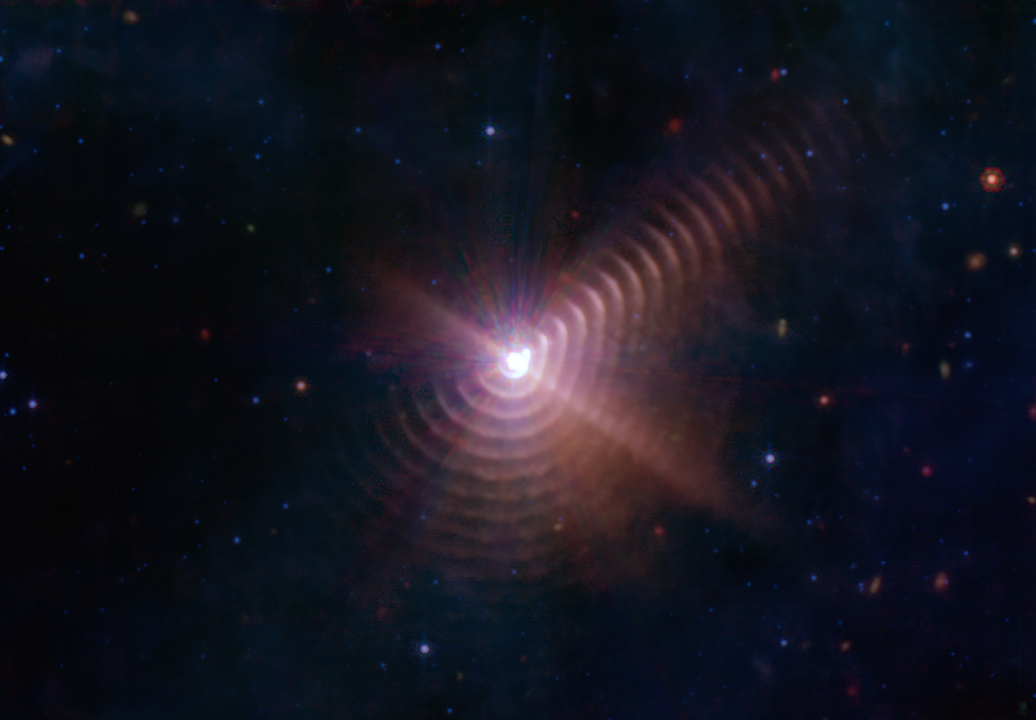
WOLF-RAYET 140
Shells of cosmic dust created by the interaction of
binary stars appear
like tree rings around Wolf-Rayet 140. The remarkable regularity of the shells’ spacing
indicates that they form like clockwork during the stars’ eight-year orbit cycle, when the
two
members of the binary make their closest approach to one another. In this image, blue,
green,
and red were assigned to Webb’s Mid-Infrared Instrument (MIRI) data at 7.7, 15, and 21
microns
(F770W, F1500W, and F2100W filters, respectively).
Read the story
Credits
IMAGE: NASA, ESA, CSA, STScI, NASA-JPL, Caltech
11 / 22
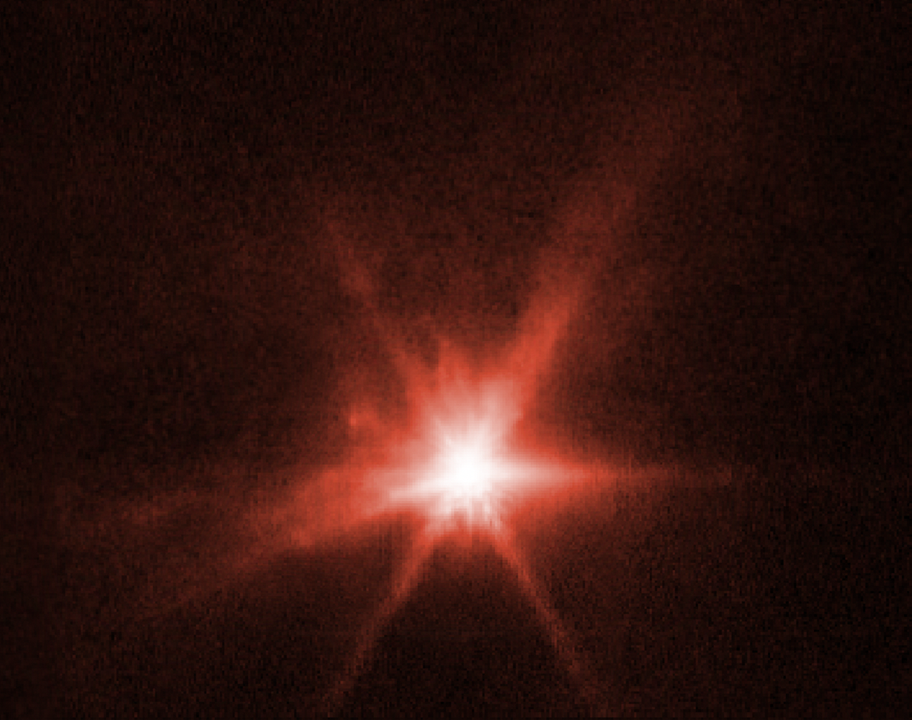
DIMORPHOS
This image from NASA’s James Webb Space Telescope’s
Near-Infrared Camera
(NIRCam) instrument shows Dimorphos, the asteroid moonlet in the double-asteroid system of
Didymos, about 4 hours after NASA’s Double Asteroid Redirection Test (DART) made impact. A
tight, compact core and plumes of material appearing as wisps streaming away from the center
of
where the impact took place, are visible in the image. Those sharp points are Webb’s
distinctive
eight diffraction spikes, an artifact of the telescope’s structure.
These observations, when combined with data from NASA’s Hubble Space Telescope, will allow
scientists to gain knowledge about the nature of the surface of Dimorphos, how much material
was
ejected by the collision, and how fast it was ejected.
In the coming months, scientists will use Webb’s Mid-Infrared Instrument (MIRI) and
Near-Infrared Spectrograph (NIRSpec) to observe ejecta from Dimorphos further. Spectroscopic
data will also provide researchers with insight into the asteroid’s chemical composition.
The observations shown here were conducted in the filter F070W (0.7 microns) and assigned
the
color red.
NIRCam was built by a team at the University of Arizona and Lockheed Martin’s Advanced
Technology Center.
Credits
SCIENCE: NASA, ESA, CSA, Cristina Thomas (Northern Arizona University), Ian Wong (NASA-GSFC)
IMAGE PROCESSING: Joseph DePasquale (STScI)
12 / 22
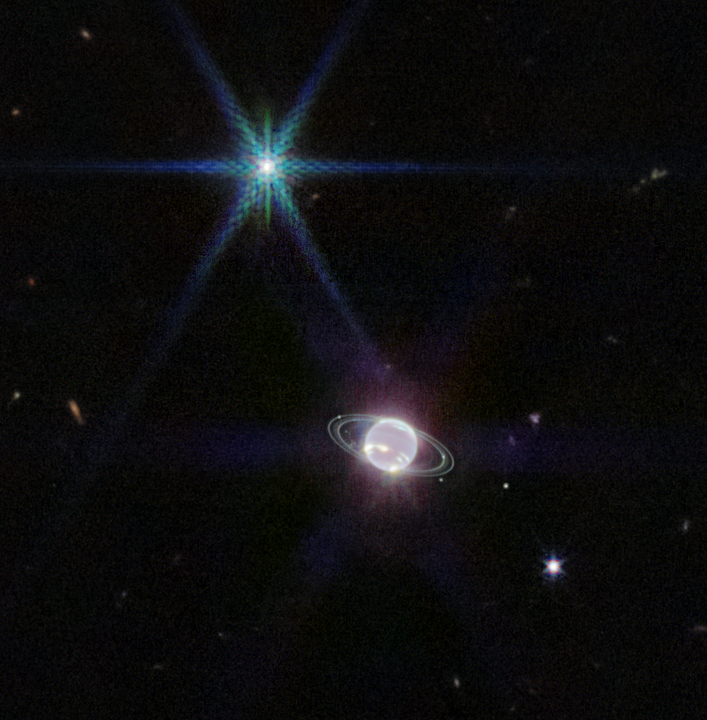
NEPTUNE IN NEAR-INFRARED
This image of the Neptune system, captured by Webb’s
Near-Infrared Camera
(NIRCam), reveals stunning views of the planet’s rings, which have not been seen with this
clarity in more than three decades. Webb’s new image of Neptune also captures details of the
planet’s turbulent, windy atmosphere.
Neptune, an ice giant, has an interior that is much richer in elements heavier than hydrogen
and
helium, like methane, than the gas giants Jupiter and Saturn. Methane appears blue in
visible
wavelengths but, as evident in Webb’s image, that’s not the case in the near-infrared.
Methane so strongly absorbs red and infrared light that the planet is quite dark at
near-infrared wavelengths, except where high-altitude clouds are present. These methane-ice
clouds are prominent in Webb’s image as bright streaks and spots, which reflect sunlight
before
it is absorbed by methane gas.
To the upper left of the planet in this image, one of Neptune’s moons, Triton, also sports
Webb’s distinctive eight diffraction spikes, an artifact of the telescope’s structure. Webb
also
captured 6 more of Neptune’s 14 known moons, along with a smattering of distant galaxies
that
appear as dim splotches and a nearby star.
NIRCam was built by a team at the University of Arizona and Lockheed Martin’s Advanced
Technology Center.
Credits
IMAGE: NASA, ESA, CSA, STScI
IMAGE PROCESSING: Joseph DePasquale (STScI), Naomi Rowe-Gurney (NASA-GSFC)
13 / 22
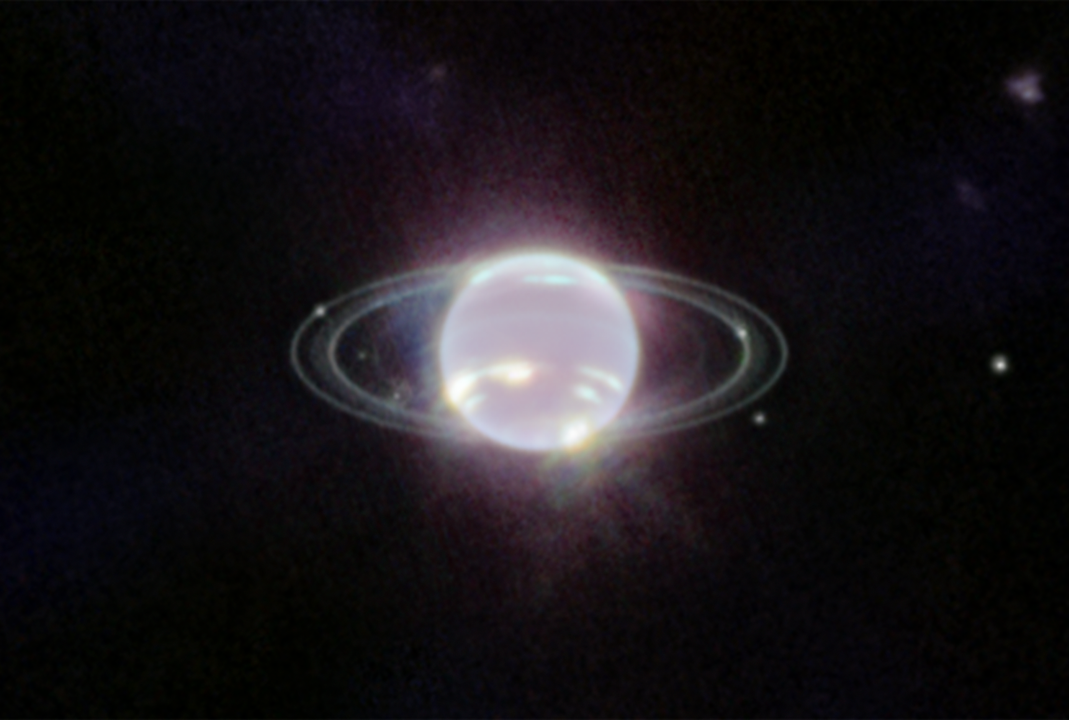
NEPTUNE IN NEAR-INFRARED
Webb’s Near-Infrared Camera (NIRCam) image of Neptune,
taken on July 12,
2022, brings the planet’s rings into full focus for the first time in more than three
decades.
The most prominent features of Neptune’s atmosphere in this image are a series of bright
patches
in the planet’s southern hemisphere that represent high-altitude methane-ice clouds. More
subtly, a thin line of brightness circling the planet’s equator could be a visual signature
of
global atmospheric circulation that powers Neptune’s winds and storms. Additionally, for the
first time, Webb has teased out a continuous band of high-latitude clouds surrounding a
previously-known vortex at Neptune’s southern pole.
NIRCam was built by a team at the University of Arizona and Lockheed Martin’s Advanced
Technology Center.
Credits
IMAGE: NASA, ESA, CSA, STScI
IMAGE PROCESSING: Joseph DePasquale (STScI), Naomi Rowe-Gurney (NASA-GSFC)
14 / 22
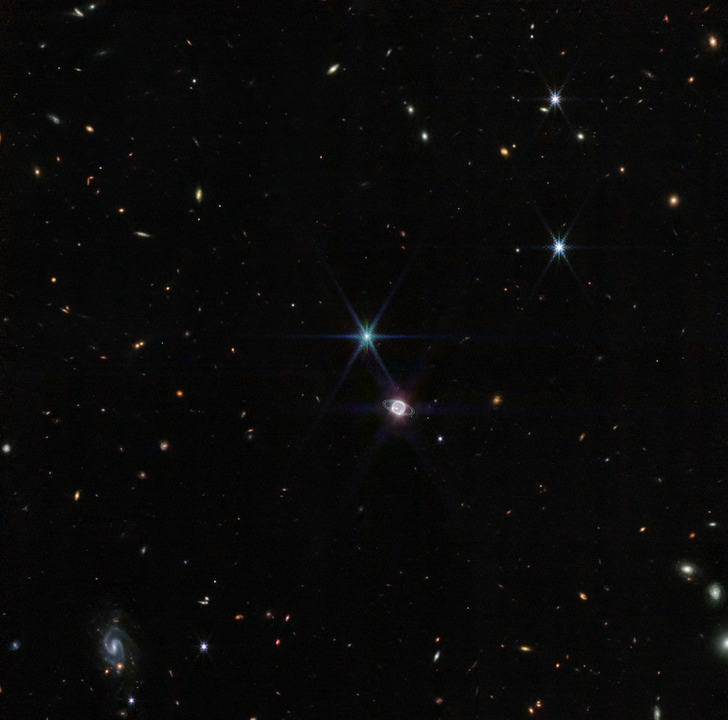
NEPTUNE AND OTHER GALAXIES IN NEAR-INFRARED
In this image by Webb’s Near-Infrared Camera (NIRCam), a
smattering of
hundreds of background galaxies, varying in size and shape, appear alongside the Neptune
system.
Neptune, when compared to Earth, is a big planet. If Earth were the size of a nickel,
Neptune
would be as big as a basketball. In most portraits, the outer planets of our solar system
reflect this otherworldly size. However, Neptune appears relatively small in a wide-field
view
of the vast universe.
Towards the bottom left of this image, a barred spiral galaxy comes into focus. Scientists
say
this particular galaxy, previously unexplored in detail, may be about a billion light-years
away. Spiral galaxies like this are typically dominated by young stars that appear blueish
in
these wavelengths.
NIRCam was built by a team at the University of Arizona and Lockheed Martin’s Advanced
Technology Center.
Credits
IMAGE: NASA, ESA, CSA, STScI
IMAGE PROCESSING: Joseph DePasquale (STScI), Naomi Rowe-Gurney (NASA-GSFC)
15 / 22
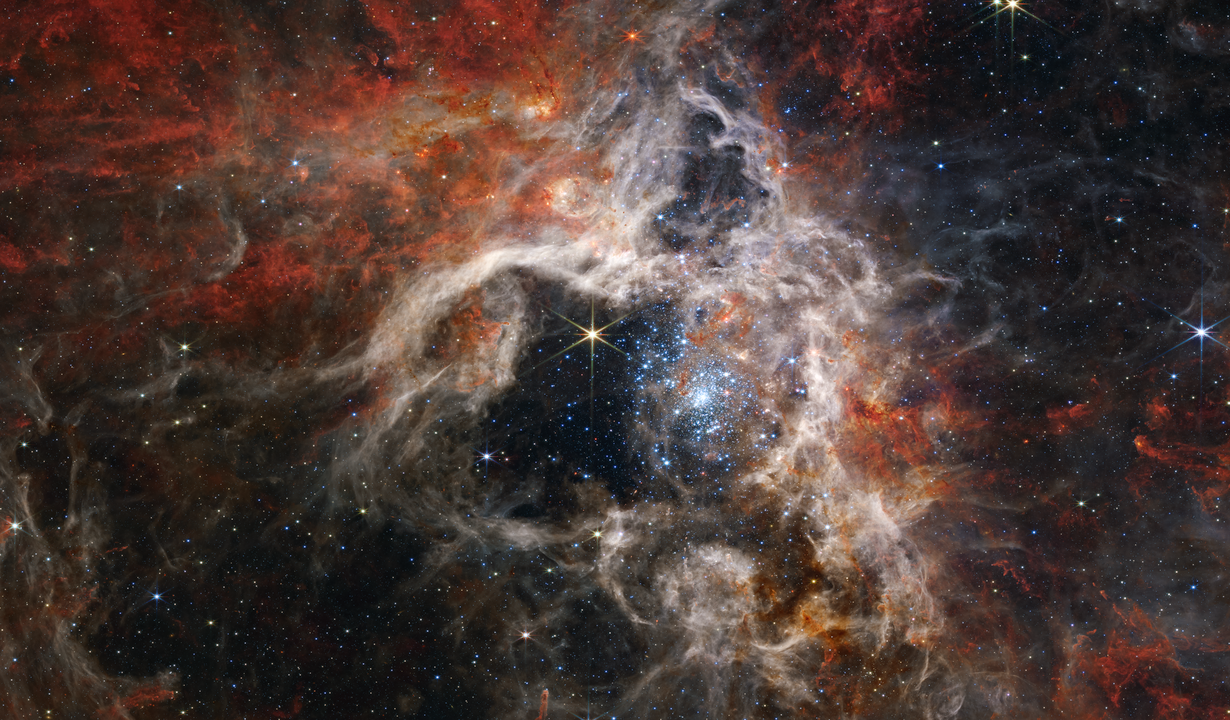
TARANTULA NEBULA (NEAR-INFRARED)
In this mosaic image stretching 340 light-years across,
Webb’s
Near-Infrared Camera (NIRCam) displays the Tarantula Nebula star-forming region in a new
light,
including tens of thousands of never-before-seen young stars that were previously shrouded
in
cosmic dust. The most active region appears to sparkle with massive young stars, appearing
pale
blue. Scattered among them are still-embedded stars, appearing red, yet to emerge from the
dusty
cocoon of the nebula. NIRCam is able to detect these dust-enshrouded stars thanks to its
unprecedented resolution at near-infrared wavelengths.
To the upper left of the cluster of young stars, and the top of the nebula’s cavity, an
older
star prominently displays NIRCam’s distinctive eight diffraction spikes, an artifact of the
telescope’s structure. Following the top central spike of this star upward, it almost points
to
a distinctive bubble in the cloud. Young stars still surrounded by dusty material are
blowing
this bubble, beginning to carve out their own cavity. Astronomers used two of Webb’s
spectrographs to take a closer look at this region and determine the chemical makeup of the
star
and its surrounding gas. This spectral information will tell astronomers about the age of
the
nebula and how many generations of star birth it has seen.
Farther from the core region of hot young stars, cooler gas takes on a rust color, telling
astronomers that the nebula is rich with complex hydrocarbons. This dense gas is the
material
that will form future stars. As winds from the massive stars sweep away gas and dust, some
of it
will pile up and, with gravity’s help, form new stars.
NIRCam was built by a team at the University of Arizona and Lockheed Martin’s Advanced
Technology Center.
Credits
IMAGE: NASA, ESA, CSA, STScI, Webb ERO Production Team
16 / 22
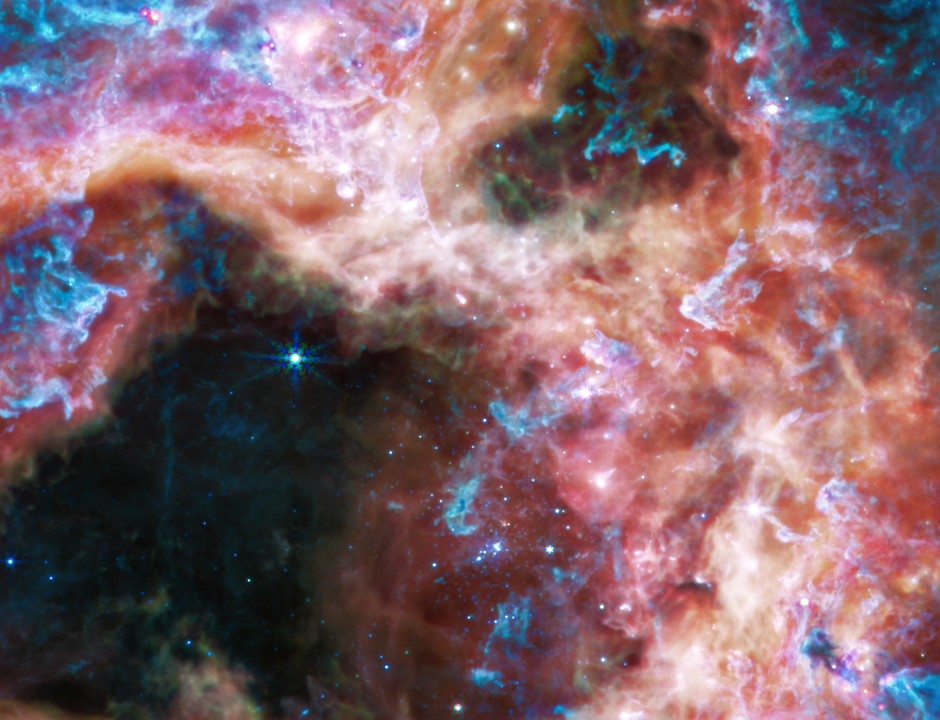
TARANTULA NEBULA (MID-INFRARED)
At the longer wavelengths of light captured by its
Mid-Infrared
Instrument (MIRI), Webb focuses on the area surrounding the central star cluster and unveils
a
very different view of the Tarantula Nebula. In this light, the young hot stars of the
cluster
fade in brilliance, and glowing gas and dust come forward. Abundant hydrocarbons light up
the
surfaces of the dust clouds, shown in blue and purple. Much of the nebula takes on a more
ghostly, diffuse appearance because mid-infrared light is able to show more of what is
happening
deeper inside the clouds. Still-embedded protostars pop into view within their dusty
cocoons,
including a bright group at the very top edge of the image, left of center.
Other areas appear dark, like in the lower-right corner of the image. This indicates the
densest
areas of dust in the nebula, that even mid-infrared wavelengths cannot penetrate. These
could be
the sites of future, or current, star formation.
MIRI was contributed by ESA and NASA, with the instrument designed and built by a
consortium of
nationally funded European Institutes (The MIRI European Consortium) in partnership with
JPL and
the University of Arizona.
Credits
IMAGE: NASA, ESA, CSA, STScI, Webb ERO Production Team
17 / 22
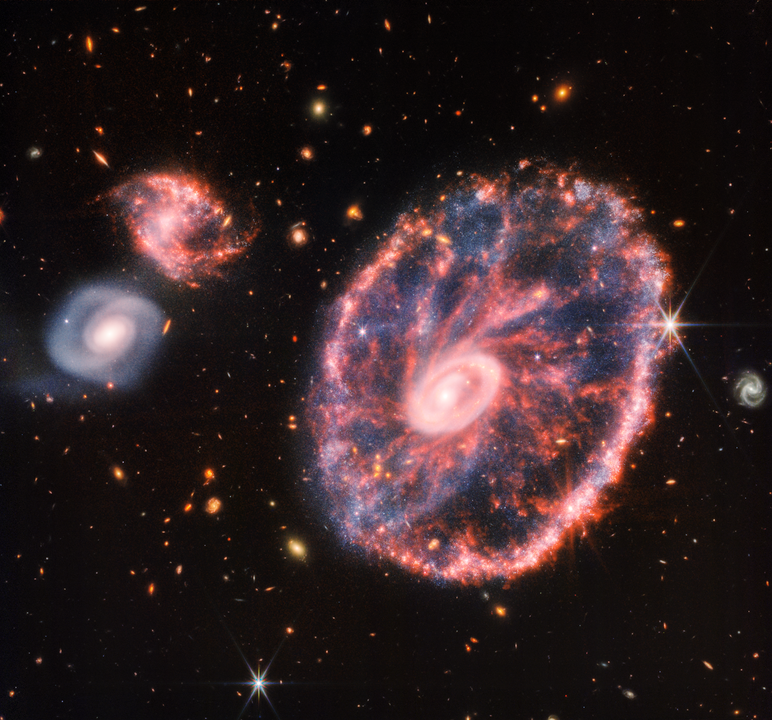
CARTWHEEL GALAXY (NIRCam-MIRI)
This image of the Cartwheel and its companion galaxies
is a composite
from Webb’s Near-Infrared Camera (NIRCam) and Mid-Infrared Instrument (MIRI), which reveals
details that are difficult to see in the individual images alone.
This galaxy formed as the result of a high-speed collision that occurred about 400 million
years
ago. The Cartwheel is composed of two rings, a bright inner ring and a colorful outer ring.
Both
rings expand outward from the center of the collision like shockwaves.
However, despite the impact, much of the character of the large, spiral galaxy that existed
before the collision remains, including its rotating arms. This leads to the “spokes” that
inspired the name of the Cartwheel Galaxy, which are the bright red streaks seen between the
inner and outer rings. These brilliant red hues, located not only throughout the Cartwheel,
but
also the companion spiral galaxy at the top left, are caused by glowing, hydrocarbon-rich
dust.
In this near- and mid-infrared composite image, MIRI data are colored red while NIRCam data
are
colored blue, orange, and yellow. Amidst the red swirls of dust, there are many individual
blue
dots, which represent individual stars or pockets of star formation. NIRCam also defines the
difference between the older star populations and dense dust in the core and the younger
star
populations outside of it.
Webb’s observations capture the Cartwheel in a very transitory stage. The form that the
Cartwheel Galaxy will eventually take, given these two competing forces, is still a mystery.
However, this snapshot provides perspective on what happened to the galaxy in the past and
what
it will do in the future.
NIRCam was built by a team at the University of Arizona and Lockheed Martin’s Advanced
Technology Center.
MIRI was contributed by ESA and NASA, with the instrument designed and built by a
consortium of
nationally funded European Institutes (The MIRI European Consortium) in partnership with
JPL and
the University of Arizona.
Credits
IMAGE: NASA, ESA, CSA, STScI, Webb ERO Production Team
18 / 22
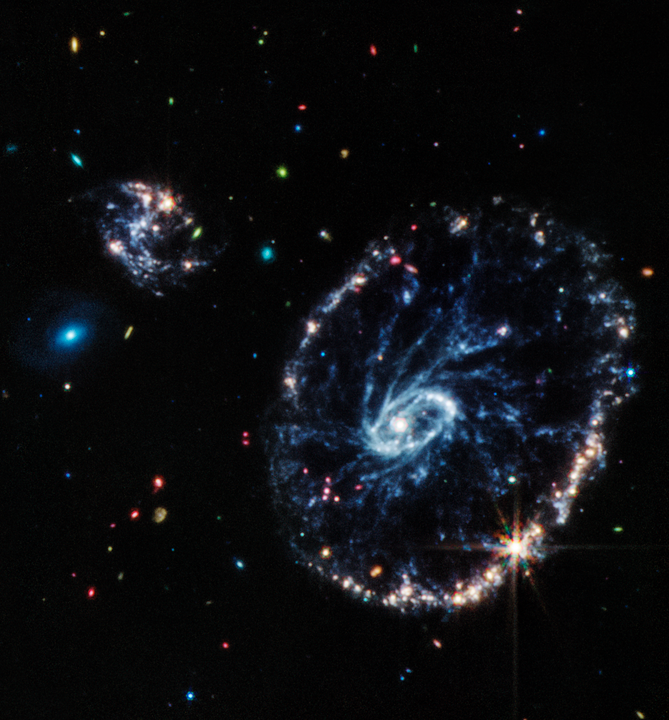
CARTWHEEL GALAXY IN MID-INFRARED
This image from Webb’s Mid-Infrared Instrument (MIRI)
shows a group of
galaxies, including a large distorted ring-shaped galaxy known as the Cartwheel. The
Cartwheel
Galaxy, located 500 million light-years away in the Sculptor constellation, is composed of a
bright inner ring and an active outer ring. While this outer ring has a lot of star
formation,
the dusty area in between reveals many stars and star clusters.
The mid-infrared light captured by MIRI reveals fine details about these dusty regions and
young
stars within the Cartwheel Galaxy, which are rich in hydrocarbons and other chemical
compounds,
as well as silicate dust, like much of the dust on Earth.
Young stars, many of which are present in the bottom right of the outer ring, energize
surrounding hydrocarbon dust, causing it to glow orange. On the other hand, the clearly
defined
dust between the core and the outer ring, which forms the “spokes” that inspire the galaxy’s
name, is mostly silicate dust.
The smaller spiral galaxy to the upper left of Cartwheel displays much of the same behavior,
showing a large amount of star formation.
MIRI was contributed by ESA and NASA, with the instrument designed and built by a
consortium of
nationally funded European Institutes (The MIRI European Consortium) in partnership with
JPL and
the University of Arizona.
Credits
IMAGE: NASA, ESA, CSA, STScI, Webb ERO Production Team
19 / 22
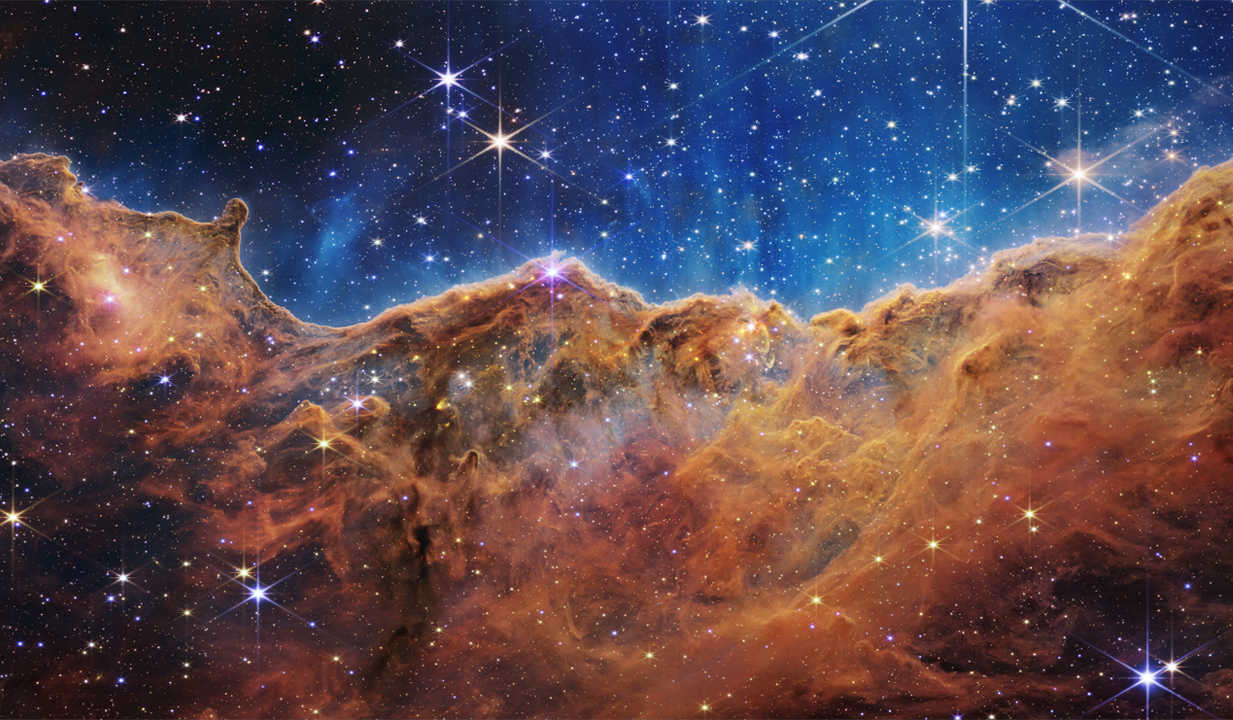
STAR FORMING IN CARINA NEBULA
What looks much like craggy mountains on a moonlit
evening is actually
the edge of a nearby, young, star-forming region NGC 3324 in the Carina Nebula. Captured in
infrared light by the Near-Infrared Camera (NIRCam) on NASA’s James Webb Space Telescope,
this
image reveals previously obscured areas of star birth.
Called the Cosmic Cliffs, the region is actually the edge of a gigantic, gaseous cavity
within
NGC 3324, roughly 7,600 light-years away. The cavernous area has been carved from the nebula
by
the intense ultraviolet radiation and stellar winds from extremely massive, hot, young stars
located in the center of the bubble, above the area shown in this image. The high-energy
radiation from these stars is sculpting the nebula’s wall by slowly eroding it away.
NIRCam – with its crisp resolution and unparalleled sensitivity – unveils hundreds of
previously
hidden stars, and even numerous background galaxies. Several prominent features in this
image
are described below.
-- The “steam” that appears to rise from the celestial “mountains” is actually hot, ionized
gas
and hot dust streaming away from the nebula due to intense, ultraviolet radiation.
-- Dramatic pillars rise above the glowing wall of gas, resisting the blistering ultraviolet
radiation from the young stars.
-- Bubbles and cavities are being blown by the intense radiation and stellar winds of
newborn
stars.
-- Protostellar jets and outflows, which appear in gold, shoot from dust-enshrouded, nascent
stars.
-- A “blow-out” erupts at the top-center of the ridge, spewing gas and dust into the
interstellar medium.
-- An unusual “arch” appears, looking like a bent-over cylinder.
This period of very early star formation is difficult to capture because, for an individual
star, it lasts only about 50,000 to 100,000 years – but Webb’s extreme sensitivity and
exquisite
spatial resolution have chronicled this rare event.
Located roughly 7,600 light-years away, NGC 3324 was first catalogued by James Dunlop in
1826.
Visible from the Southern Hemisphere, it is located at the northwest corner of the Carina
Nebula
(NGC 3372), which resides in the constellation Carina. The Carina Nebula is home to the
Keyhole
Nebula and the active, unstable supergiant star called Eta Carinae.
NIRCam was built by a team at the University of Arizona and Lockheed Martin’s Advanced
Technology Center.
For a full array of Webb’s first images and spectra, including downloadable files, please
visit:
https://webbtelescope.org/news/first-images
Credits
IMAGE: NASA, ESA, CSA, STScI
20 / 22
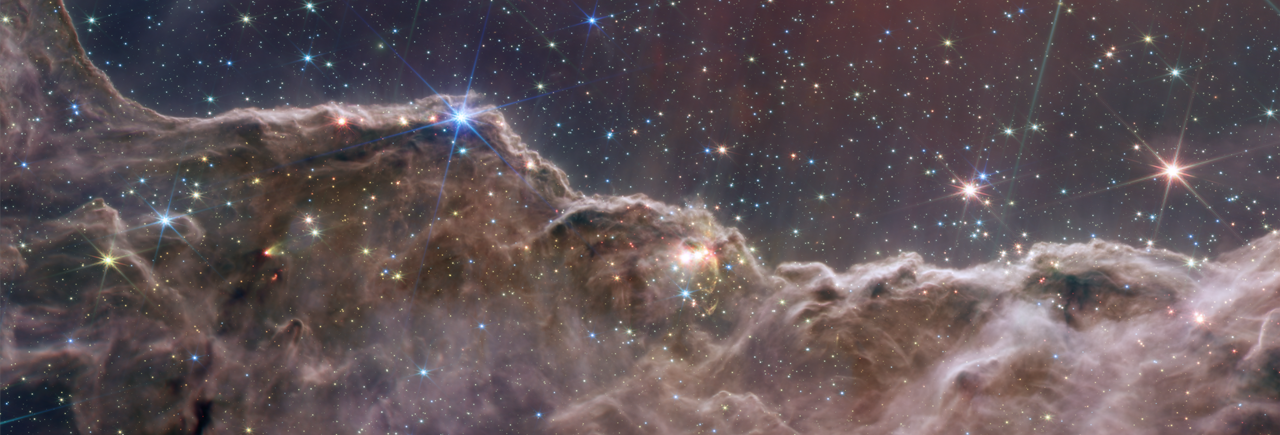
STAR FORMING IN CARINA NEBULA
Astronomers using NASA’s James Webb Space Telescope
combined the
capabilities of the telescope’s two cameras to create a never-before-seen view of a
star-forming
region in the Carina Nebula. Captured in infrared light by the Near-Infrared Camera (NIRCam)
and
Mid-Infrared Instrument (MIRI), this combined image reveals previously invisible areas of
star
birth.
What looks much like craggy mountains on a moonlit evening is actually the edge of a nearby,
young, star-forming region known as NGC 3324. Called the Cosmic Cliffs, this rim of a
gigantic,
gaseous cavity is roughly 7,600 light-years away.
The cavernous area has been carved from the nebula by the intense ultraviolet radiation and
stellar winds from extremely massive, hot, young stars located in the center of the bubble,
above the area shown in this image. The high-energy radiation from these stars is sculpting
the
nebula’s wall by slowly eroding it away.
NIRCam – with its crisp resolution and unparalleled sensitivity – unveils hundreds of
previously
hidden stars, and even numerous background galaxies. In MIRI’s view, young stars and their
dusty, planet-forming disks shine brightly in the mid-infrared, appearing pink and red. MIRI
reveals structures that are embedded in the dust and uncovers the stellar sources of massive
jets and outflows. With MIRI, the hydrocarbons and other chemical compounds on the surface
of
the ridges glow, giving the appearance of jagged rocks.
Several prominent features in this image are described below.
-- The faint “steam” that appears to rise from the celestial “mountains” is actually hot,
ionized gas and hot dust streaming away from the nebula due to intense, ultraviolet
radiation.
-- Peaks and pillars rise above the glowing wall of gas, resisting the blistering
ultraviolet
radiation from the young stars.
-- Bubbles and cavities are being blown by the intense radiation and stellar winds of
newborn
stars.
-- Protostellar jets and outflows, which appear in gold, shoot from dust-enshrouded, nascent
stars. MIRI uncovers the young, stellar sources producing these features. For example, a
feature
at left that looks like a comet with NIRCam is revealed with MIRI to be one cone of an
outflow
from a dust-enshrouded, newborn star.
-- A “blow-out” erupts at the top-center of the ridge, spewing material into the
interstellar
medium. MIRI sees through the dust to unveil the star responsible for this phenomenon.
-- An unusual “arch,” looking like a bent-over cylinder, appears in all wavelengths shown
here.
This period of very early star formation is difficult to capture because, for an individual
star, it lasts only about 50,000 to 100,000 years – but Webb’s extreme sensitivity and
exquisite
spatial resolution have chronicled this rare event.
NGC 3324 was first catalogued by James Dunlop in 1826. Visible from the Southern Hemisphere,
it
is located at the northwest corner of the Carina Nebula (NGC 3372), which resides in the
constellation Carina. The Carina Nebula is home to the Keyhole Nebula and the active,
unstable
supergiant star called Eta Carinae.
NIRCam was built by a team at the University of Arizona and Lockheed Martin’s Advanced
Technology Center.
MIRI was contributed by ESA and NASA, with the instrument designed and built by a
consortium of
nationally funded European Institutes (The MIRI European Consortium) in partnership with
JPL and
the University of Arizona.
For a full array of Webb’s first images and spectra, including downloadable files, please
visit:
https://webbtelescope.org/news/first-images
Credits
IMAGE: NASA, ESA, CSA, STScI
21 / 22
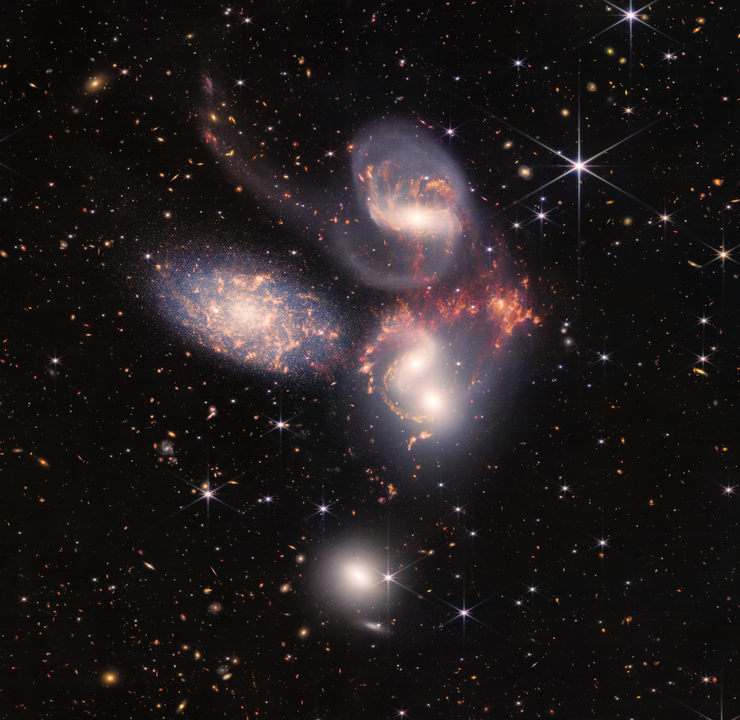
STEPHAN'S QUINTET (NIRCam-MIRI)
An enormous mosaic of Stephan’s Quintet is the largest
image to date from
NASA’s James Webb Space Telescope, covering about one-fifth of the Moon’s diameter. It
contains
over 150 million pixels and is constructed from almost 1,000 separate image files. The
visual
grouping of five galaxies was captured by Webb’s Near-Infrared Camera (NIRCam) and
Mid-Infrared
Instrument (MIRI).
With its powerful, infrared vision and extremely high spatial resolution, Webb shows
never-before-seen details in this galaxy group. Sparkling clusters of millions of young
stars
and starburst regions of fresh star birth grace the image. Sweeping tails of gas, dust and
stars
are being pulled from several of the galaxies due to gravitational interactions. Most
dramatically, Webb’s MIRI instrument captures huge shock waves as one of the galaxies, NGC
7318B, smashes through the cluster. These regions surrounding the central pair of galaxies
are
shown in the colors red and gold.
This composite NIRCam-MIRI image uses two of the three MIRI filters to best show and
differentiate the hot dust and structure within the galaxy. MIRI sees a distinct difference
in
color between the dust in the galaxies versus the shock waves between the interacting
galaxies.
The image processing specialists at the Space Telescope Science Institute in Baltimore opted
to
highlight that difference by giving MIRI data the distinct yellow and orange colors, in
contrast
to the blue and white colors assigned to stars at NIRCam’s wavelengths.
Together, the five galaxies of Stephan’s Quintet are also known as the Hickson Compact Group
92
(HCG 92). Although called a “quintet,” only four of the galaxies are truly close together
and
caught up in a cosmic dance. The fifth and leftmost galaxy, called NGC 7320, is well in the
foreground compared with the other four. NGC 7320 resides 40 million light-years from Earth,
while the other four galaxies (NGC 7317, NGC 7318A, NGC 7318B, and NGC 7319) are about 290
million light-years away. This is still fairly close in cosmic terms, compared with more
distant
galaxies billions of light-years away. Studying these relatively nearby galaxies helps
scientists better understand structures seen in a much more distant universe.
This proximity provides astronomers a ringside seat for witnessing the merging of and
interactions between galaxies that are so crucial to all of galaxy evolution. Rarely do
scientists see in so much exquisite detail how interacting galaxies trigger star formation
in
each other, and how the gas in these galaxies is being disturbed. Stephan’s Quintet is a
fantastic “laboratory” for studying these processes fundamental to all galaxies.
Tight groups like this may have been more common in the early universe when their
superheated,
infalling material may have fueled very energetic black holes called quasars. Even today,
the
topmost galaxy in the group – NGC 7319 – harbors an active galactic nucleus, a supermassive
black hole that is actively accreting material.
In NGC 7320, the leftmost and closest galaxy in the visual grouping, NIRCam was remarkably
able
to resolve individual stars and even the galaxy’s bright core. Old, dying stars that are
producing dust clearly stand out as red points with NIRCam.
The new information from Webb provides invaluable insights into how galactic interactions
may
have driven galaxy evolution in the early universe.
As a bonus, NIRCam and MIRI revealed a vast sea of many thousands of distant background
galaxies
reminiscent of Hubble’s Deep Fields.
NIRCam was built by a team at the University of Arizona and Lockheed Martin’s Advanced
Technology Center.
MIRI was contributed by ESA and NASA, with the instrument designed and built by a
consortium of
nationally funded European Institutes (The MIRI European Consortium) in partnership with
JPL and
the University of Arizona.
For a full array of Webb’s first images and spectra, including downloadable files, please
visit:
https://webbtelescope.org/news/first-images
Credits
IMAGE: NASA, ESA, CSA, STScI
22 / 22
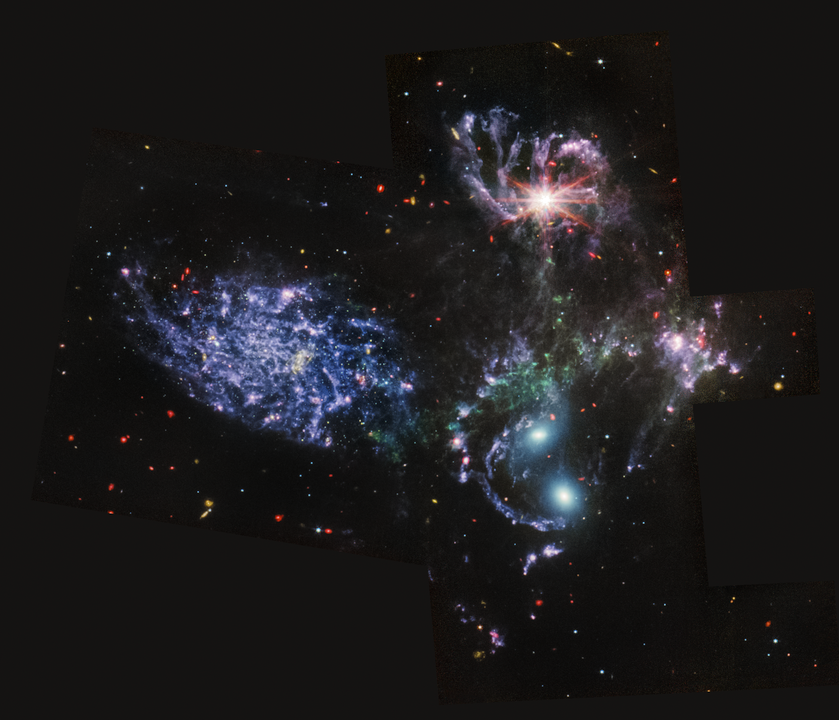
STEPHAN'S QUINTET (MIRI)
With its powerful, mid-infrared vision, the Mid-Infrared
Instrument
(MIRI) shows never-before-seen details of Stephan’s Quintet, a visual grouping of five
galaxies.
MIRI pierced through dust-enshrouded regions to reveal huge shock waves and tidal tails, gas
and
stars stripped from the outer regions of the galaxies by interactions. It also unveiled
hidden
areas of star formation. The new information from MIRI provides invaluable insights into how
galactic interactions may have driven galaxy evolution in the early universe.
This image contains one more MIRI filter than was used in the NIRCam-MIRI composite picture.
The
image processing specialists at the Space Telescope Science Institute in Baltimore opted to
use
all three MIRI filters and the colors red, green and blue to most clearly differentiate the
galaxy features from each other and the shock waves between the galaxies.
In this image, red denotes dusty, star-forming regions, as well as extremely distant, early
galaxies and galaxies enshrouded in thick dust. Blue point sources show stars or star
clusters
without dust. Diffuse areas of blue indicate dust that has a significant amount of large
hydrocarbon molecules. For small background galaxies scattered throughout the image, the
green
and yellow colors represent more distant, earlier galaxies that are rich in these
hydrocarbons
as well.
Stephan’s Quintet’s topmost galaxy – NGC 7319 – harbors a supermassive black hole 24 million
times the mass of the Sun. It is actively accreting material and puts out light energy
equivalent to 40 billion Suns. MIRI sees through the dust surrounding this black hole to
unveil
the strikingly bright active galactic nucleus.
As a bonus, the deep mid-infrared sensitivity of MIRI revealed a sea of previously
unresolved
background galaxies reminiscent of Hubble’s Deep Fields.
Together, the five galaxies of Stephan’s Quintet are also known as the Hickson Compact Group
92
(HCG 92). Although called a “quintet,” only four of the galaxies are truly close together
and
caught up in a cosmic dance. The fifth and leftmost galaxy, called NGC 7320, is well in the
foreground compared with the other four. NGC 7320 resides 40 million light-years from Earth,
while the other four galaxies (NGC 7317, NGC 7318A, NGC 7318B, and NGC 7319) are about 290
million light-years away. This is still fairly close in cosmic terms, compared with more
distant
galaxies billions of light-years away. Studying these relatively nearby galaxies helps
scientists better understand structures seen in a much more distant universe.
This proximity provides astronomers a ringside seat for witnessing the merging of and
interactions between galaxies that are so crucial to all of galaxy evolution. Rarely do
scientists see in so much exquisite detail how interacting galaxies trigger star formation
in
each other, and how the gas in these galaxies is being disturbed. Stephan’s Quintet is a
fantastic “laboratory” for studying these processes fundamental to all galaxies.
Tight groups like this may have been more common in the early universe when their
superheated,
infalling material may have fueled very energetic black holes called quasars. Even today,
the
topmost galaxy in the group – NGC 7319 – harbors an active galactic nucleus, a supermassive
black hole that is actively pulling in material.
MIRI was contributed by ESA and NASA, with the instrument designed and built by a
consortium of
nationally funded European Institutes (The MIRI European Consortium) in partnership with
JPL and
the University of Arizona.
For a full array of Webb’s first images and spectra, including downloadable files, please
visit:
https://webbtelescope.org/news/first-images
Credits
IMAGE: NASA, ESA, CSA, STScI