Information
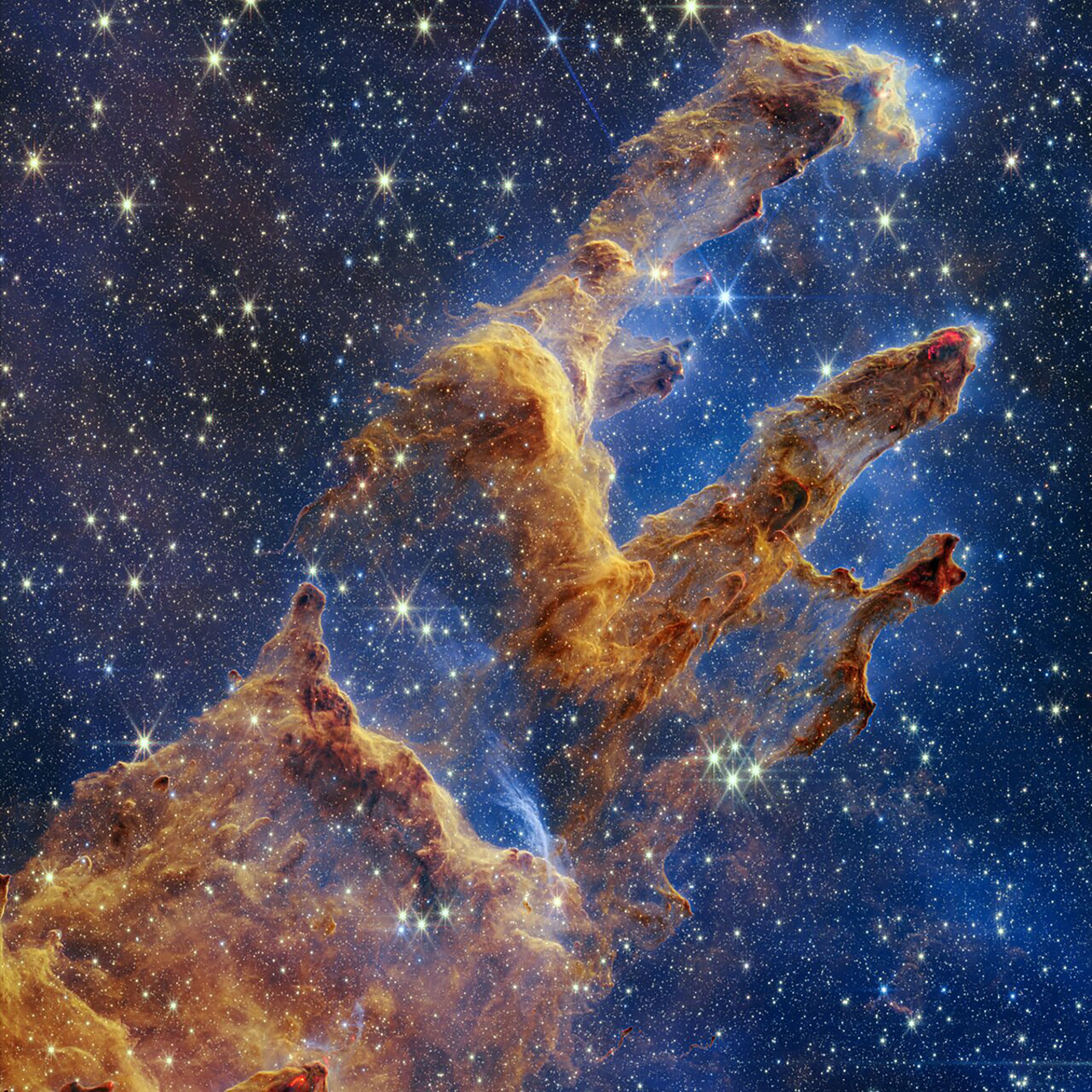
The James Webb Space Telescope is an infrared observatory orbiting the Sun about 1 million
miles
from Earth to find the first galaxies that formed in the early universe and to see stars forming planetary
systems.
The Webb telescope is named after James E. Webb (1906–1992), NASA's second administrator. James Webb is best
known for leading Apollo, the series of exploration programs that landed the first humans on the Moon. He also
initiated a vigorous space science program that was responsible for more than 75 launches during his tenure,
including America's first interplanetary explorer spacecrafts.
The James Webb Space Telescope features a 6.5 meter segmented primary mirror and 4 science instruments, each
of
which offers a variety of configurations and operating modes for infrared observing.
To accurately and precisely detect faint infrared light from distant objects in the universe, Webb must be
shielded from the strong infrared light emanating nearby from the Sun, Earth, and Moon. The sunshield’s five
layers block the light from these nearby objects.
Webb is designed to have a minimum five years of science operations, with the goal of having an overall
mission
lifetime greater than 10 years.
Webb has four scientific instruments, the Near-Infrared Camera (NIRCam), the Near-Infrared Spectrograph
(NIRSpec), the Near-Infrared Imager and Slitless Spectrograph (NIRISS), and the Mid-Infrared Instrument
(MIRI).
Each of these instruments uses infrared detectors to capture light from distant astronomical sources.
The Webb telescope is powered by an on-board solar array. It also has a propulsion system to maintain the
observatory’s orbit and attitude. The solar array provides 2,000 watts of electrical power for the life of the
mission, and there is enough propellant onboard for at least 10 years of science operations.
Webb can downlink at least 57.2 gigabytes of recorded science data each day, with a maximum data rate of 28
megabits per second.
The sunshield layers are built with ripstops included, so if something pierced a layer, it couldn't rip very
far, allowing the layer to maintain structural integrity.
The primary mirror segments and secondary mirror are moved by six actuators that are attached to the backs of
the mirrors. The primary segments have an additional actuator at the center of the mirror to adjust their
curvature. Those seven spots are adjustable to align the 18 segments of the primary mirror to each other, and
adjust the primary and secondary mirrors to the fixed tertiary mirror and the instruments.
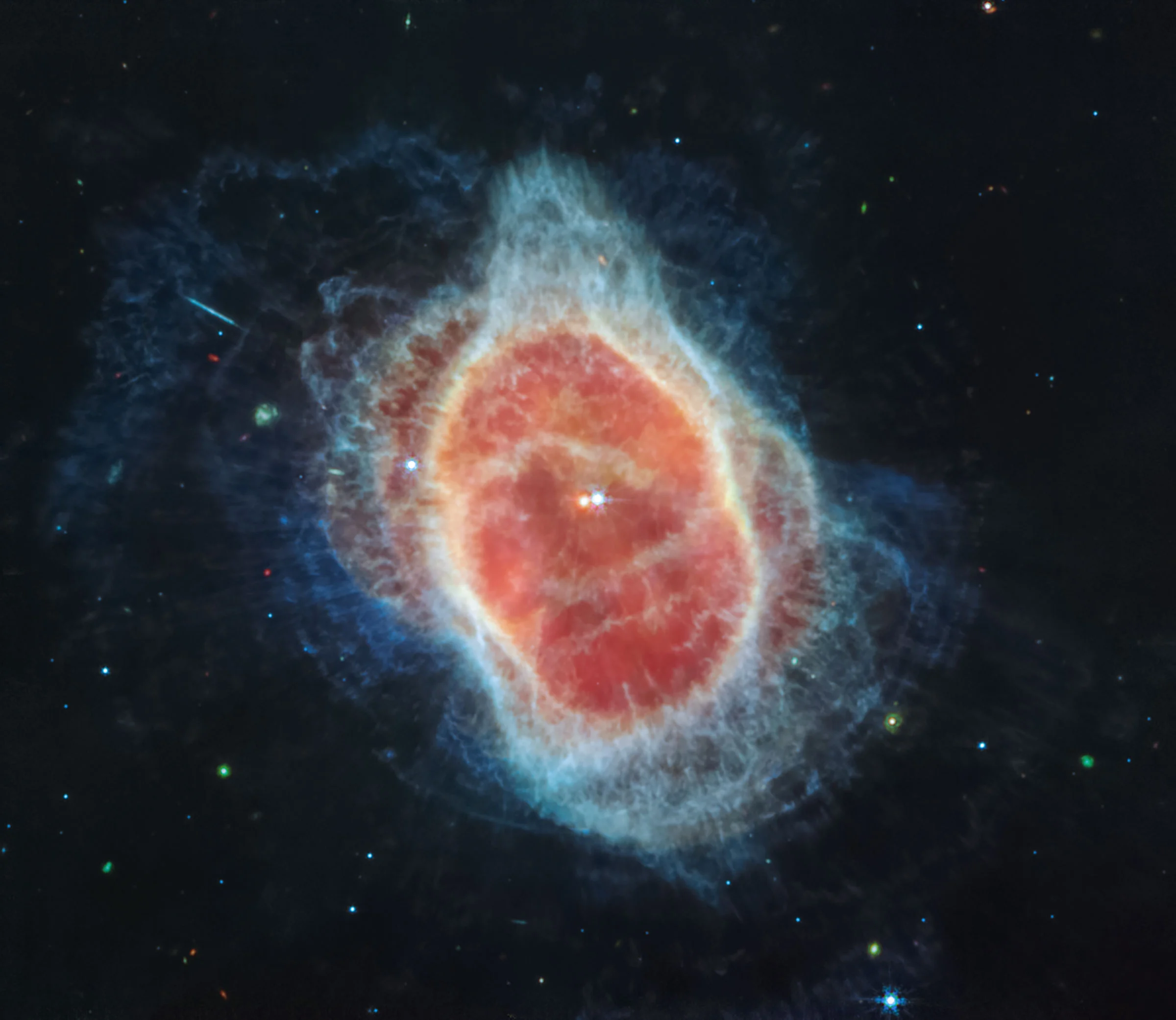
Webb will study both the far and near universe. Astronomers will use it to see infrared light emanating from
planets and objects in our solar system, exoplanets, star clusters, nebulae, other galaxies, and the most
distant reaches in the universe.
Webb will be able to observe galaxies that formed about 400 million years after the big bang.
Webb will be able to observe certain hot, young exoplanets using a technique called direct imaging.
Equipped with sensitive spectrographs, Webb will be able to detect oxygen and other organic molecules in the
atmospheres of nearby exoplanets. These molecules will reveal clues to the potential habitability of other
worlds.
NASA’s James Webb space telescope has produced the deepest and clearest infrared image in the distant universe
to date.
Thousands of galaxies – with the weakest objects ever seen in the infrared – appeared for the first time in
the
view of Webb. This slice of the vast universe covers a piece of sky whose size roughly corresponds to that of
a
grain of sand held at arm's length by a person on the ground.
While the Hubble Telescope's goal is to capture distant stars and galaxies, it remains close—in the earth's
orbit. The James Webb telescope was always meant for long-term exposure and deep space capturing with hopes of
retrieving data on galaxies set apart by lightyears upon lightyears.
A massive difference between the two space-science juggernauts is their placement. The Hubble has been in
low-earth orbit for more than three decades, while the James Webb has already spent its first eight months
outside of earth's orbit.
While the Hubble orbits nearly 570 km away from earth, the James Webb orbits over 1 million km away from
earth;
NASA notes these not as pros and cons, but simple differences. While the safety of Hubble remains a comfort
for
NASA, the James Webb risks much in order to capture greatness. Its orbit is much farther removed but will
yield
more groundbreaking results. Perhaps the coolest difference between the two telescopes is that, while Hubble
has
been able to capture awesome, lightyears-old galaxies, the James Webb is believed by NASA to have the ability
to
see some of the first galaxies and stars in existence. This is both a result of its mammoth mirror and
light-capturing abilities, as well as its duration in space.
The Spitzer Space Telescope, launched in 2003, was NASA's Infrared Great Observatory. Among many other
accomplishments in its 16 years of operation, Spitzer discovered a giant ring of Saturn, revealed a system of
seven Earth-size planets around a star 40 light-years away, and studied the most distant known galaxies.